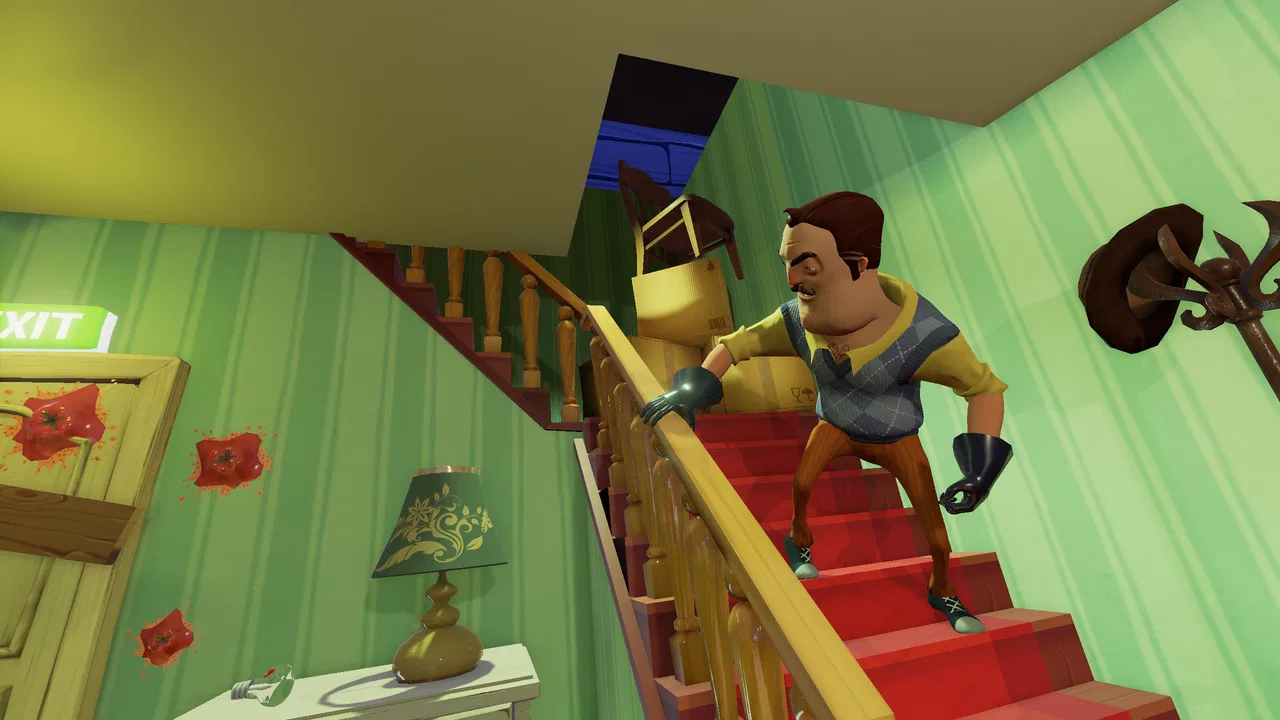
Hello Neighbor
- 3.9
- Rating
- 50.00M
- Installs
- Free
- Price

 Analysis by App-foxy
Some adventure games ask me to relax into exploration; Hello Neighbor asks me to keep moving while wondering whether I have made a terrible mistake. I played it as a stealth-horror game built around sneaking into a neighbor’s house, testing routes, and learning from the moments when the adaptive AI catches me. That combination gives it a very particular rhythm: curiosity pulls me forward, then tension makes even a familiar hallway feel unsafe.
Developed by tinyBuild, this is a free game for Android devices, aimed at players aged 10 and over. It has reached more than 50 million installs, which makes its broad appeal easy to understand, although its average rating of 3.9 from roughly 540 thousand ratings also suggests a mixed experience rather than a universal recommendation. I think that balance is fair. The central idea is memorable and the atmosphere works, but the mobile controls and trial-and-error design can be demanding.
How the house communicates its puzzles
The first thing I noticed was how much of the game depends on visual reading. The house is not presented as a neat sequence of rooms with obvious instructions. Instead, I had to look at doors, windows, objects, gaps, and unusual pieces of furniture, then decide what might be useful. The environment often communicates more effectively than a written explanation, which suits the mystery but places extra pressure on players who need strong contrast, larger text, or a calmer visual presentation.
You May Also Like

 AccuWeather: Weather Radar
AccuWeather Review: A Quick, Clear Forecast for Everyday Decisions
For everyday plans, the best forecast is the one you can understand quickly. AccuWeather makes rain timing, radar, and local conditions easy to act on, with a few trade-offs.

 Hill Climb Racing
Why Hill Climb Racing Still Turns Crashes Into One More Run
A tiny car, a bumpy hill and one more upgrade: Hill Climb Racing keeps resurfacing because its simple chaos makes every near-miss feel personal.

 AliExpress - Shopping App
AliExpress Makes Global Shopping Feel Personal, but Shoppers Bear the Risk
AliExpress turns a global marketplace into a pocket-sized discovery engine. Its reach is useful, its shopping loop compelling, and its trade-offs easy to miss.

 Lords Mobile: Kingdom Wars
Lords Mobile Is a Kingdom-Building Routine, Not a Quick Match
A case-by-case verdict on the building, battles, device demands, and social commitments that make Lords Mobile rewarding for some players and exhausting for others.

 PDF Scanner app - TapScanner
TapScanner Makes Paperwork Easier to Capture, Check, and Share
TapScanner makes scanning with a phone feel less like a rescue operation and more like a dependable step in getting work done. Its capture tools are useful, though not flawless.

 Block Blast!
 Shows How Much a Puzzle Game Can Leave Out
A quiet grid game shows why puzzle players increasingly value instant clarity, repeatable skill and low-pressure play—and where the genre still needs to catch up.
More From Our News Desk
View All News


Navigation is deliberately uncertain. I was not simply following an arrow from one objective to the next; I was building a mental map while avoiding detection. That can feel rewarding when I finally understood how two areas connected, but it can also become tiring when I had forgotten where an item was left or why a particular room mattered. The game benefits from taking a slow approach and mentally grouping spaces by landmarks rather than trying to memorize every turn.
For readability, the most useful habit is to pause before interacting. I found that rushing caused me to miss small visual clues and waste time repeating the same attempt. Looking at the scene from different angles helped me distinguish decorative objects from things that could affect my route. This is not an accessibility setting, but it is a practical way to reduce visual overload: I treated each room as a short observation task instead of scanning the whole house at once.
The lack of constant explanation is part of the appeal, yet it also means the game does not always make its intentions clear. Players who enjoy interpreting spaces may find that satisfying. Someone who prefers explicit objectives, clean menus, and predictable signposting may feel lost before the horror has even had a chance to work. Compared with a more traditional mobile adventure game, this one asks the player to supply more of the organization.
Learning the interface instead of fighting it
On a touchscreen, the interface becomes part of the challenge. Movement, looking around, and interacting all need to happen while I am watching for danger. My first attempts felt less precise than playing a stealth game with physical controls, particularly when I needed to turn quickly or pick up something under pressure. I became more comfortable when I used deliberate, shorter movements rather than dragging rapidly and hoping the camera would settle in the right place.
That adjustment matters because mistakes are rarely isolated. A slightly awkward turn can expose me, exposure can trigger a chase, and the chase can force me to abandon the plan I had just formed. I recommend learning the basic movement in a safe moment rather than trying to understand it during the most stressful encounter. This is one of the clearest practical tips for mobile play: treat control familiarity as preparation, not something that will automatically arrive after a few minutes.
Menus and interactions are not the main attraction, so I appreciated that the game keeps attention on the house rather than surrounding the play area with unnecessary information. At the same time, a sparse interface can be less forgiving for players who rely on strong visual confirmation. When I was unsure whether an interaction had registered, I sometimes repeated it and lost valuable time. That friction is small in a quiet moment and much larger when the neighbor is nearby.
The current version is 2.3.15 and it runs on Android 8.0 or later. That makes it available to a wide range of compatible devices, but compatibility alone does not guarantee an equally comfortable experience on every phone. Screen size, touch response, performance, and speaker quality can all change how manageable the game feels. I would be more confident recommending it on a device with a responsive display and enough room for the controls than on a small, crowded screen.
Motor, sensory, and situational demands
The motor demands come from combining movement with camera control and quick reactions. I was often doing several things at once: positioning myself near cover, checking a doorway, deciding whether to grab an object, and preparing an escape route. That multitasking can be enjoyable for players who like pressure, but it may be uncomfortable for anyone affected by rapid camera movement, repeated touch gestures, or the need to react without much warning.
I found a useful workaround in planning escapes before attempting an action. Rather than entering a room with no idea where to go, I identified a nearby exit or hiding direction first. This reduced frantic movement and made failures feel more informative. It also changes the game from a reflex test into a planning exercise, which is a better fit for players who enjoy stealth but do not want every mistake to depend on fast finger movement.
The horror comes from anticipation as much as from direct confrontation. The neighbor’s presence, sudden pursuit, and uncertainty about what the adaptive AI has learned can create a strong sensory response even when the screen is not constantly showing something frightening. Headphones can make the experience more atmospheric, but they can also make surprise sounds more intense. I preferred a moderate volume, especially when playing for longer sessions.
Players sensitive to suspense, abrupt movement, or repeated failure should know that the game’s tension is not a brief decoration around the puzzles. It shapes the entire loop. I sometimes needed a break after several failed attempts, not because the game was technically exhausting, but because constant vigilance made simple decisions feel heavier. A quieter adventure game would be a better choice for someone seeking exploration without pressure.
Visual style also affects how easy it is to read the environment. The exaggerated presentation gives the house personality and keeps it from feeling like a realistic simulation, but visual personality is not the same as clarity. Objects can blend into a busy room, and the need to inspect several possibilities may be frustrating for players who need strong separation between interactive and decorative elements. I learned to rely on repeated observation rather than assuming the most noticeable object was the important one.
Why the adaptive opponent changes the experience
The adaptive AI is more than a label attached to the horror. It changes how I approached familiar situations. A route that seemed safe could become unreliable after repeated use, so I had to vary my behavior instead of perfecting one sequence and repeating it forever. That is a clever source of tension, but it also makes the game harder to explain to a player who wants stable rules.
My strongest strategy was to experiment in small pieces. I tested one entrance, watched the result, and changed only one part of the plan on the next attempt. If I altered everything at once, I could not tell what had helped. This method is especially useful for players who find unpredictable opponents stressful, because it turns the AI into something to study rather than an invisible force that simply ruins progress.
There is a trade-off here. Adaptive behavior can make the game feel more alive than a fixed patrol pattern, but it can also make failure feel less consistent. When I wanted a dependable stealth puzzle, I sometimes preferred a predictable route. When I wanted the house to remain unsettling after I had already learned it, the changing behavior was the feature that kept the experience interesting.
Playing in different everyday contexts
Hello Neighbor works best when I can give it focused attention. In a quiet room, I could notice environmental details, remember where I had left objects, and listen for danger. On a busy commute or during a short break, the same game felt less comfortable because interruptions made it harder to maintain a mental map. Missing a visual cue or returning after a distraction can turn a clever puzzle into a sequence of guesses.
A realistic use case is a short evening session in which I choose one small goal: investigate one area, test one route, or retrieve one object. That approach is more satisfying than opening the game with the vague intention of “making progress.” The house contains enough uncertainty that a modest objective gives the session shape, and stopping after a useful discovery feels better than continuing until frustration takes over.
I would not choose it as a background game while listening to a podcast or watching television. It demands visual attention and benefits from sound awareness, so divided attention removes much of what makes the stealth work. It is also a poor fit for a shared space where sudden tension or repeated restarts might disturb other people. For a private, focused session, however, the atmosphere has room to develop.
The game is free to download, with in-app purchases ranging from $0.99 to $14.99 per item. I would approach those purchases carefully and first decide whether the core play style suits me. The important question is not simply whether the initial download costs nothing; it is whether I am enjoying the investigation enough to keep playing without turning the experience into an impulse purchase. Players who dislike optional spending in free games should set their own limit before starting.
Its age rating of Everyone 10+ makes it more approachable than an explicitly graphic horror game, but younger players can still react differently to suspense and pursuit. I would judge it by the individual player rather than the label alone. A child who enjoys spooky cartoon-like adventures may be comfortable, while another player of the same age may find the uncertainty and chase sequences too intense.
Who will appreciate it, and who should skip it
I think it is a good match for players who like environmental puzzles, stealth experimentation, and stories that reveal themselves through spaces rather than long explanations. It is also suitable for someone who enjoys replaying a situation with a new plan after failure. The adaptive opponent gives patient players a reason to keep observing instead of treating every loss as a dead end.
I would skip it if I wanted a straightforward adventure with clearly marked objectives, forgiving controls, or a steady narrative pace. I would also hesitate to recommend it to anyone who becomes motion-sick from camera movement, dislikes being chased, or needs highly predictable interaction timing. A turn-based puzzle game would offer more control over pacing, while a conventional action-adventure game would usually provide clearer direction.
Compared with other mobile horror games, this one leans less on combat and more on trespassing, hiding, and interpreting the environment. Compared with ordinary puzzle adventures, it adds pressure through pursuit and uncertainty. That middle position is its identity, but it also means it may disappoint players arriving from either side: horror fans who want constant intensity may find the investigation slow, while puzzle fans may find the interruptions too stressful.
Remaining barriers and practical ways to reduce them
The biggest barrier in my experience is the combination of unclear objectives and touchscreen precision. Neither problem makes the game impossible, but together they can create a steep opening. I improved the experience by keeping sessions focused, moving slowly near interactive objects, and treating each failed attempt as evidence. Writing down a brief note about a useful route or item can also help when returning after a break.
Another barrier is cognitive load. The game asks me to remember locations, interpret clues, monitor the neighbor, and react to changing behavior. Players who are comfortable with one task at a time may find the combination tiring. A simple self-imposed rule helped: I did not attempt a risky action until I knew where I would retreat. That reduced the number of decisions I had to make during a chase.
Sound can be both helpful and demanding. Audio awareness supports stealth because it contributes to the sense of nearby danger, but a loud or busy environment can make the game harder to read. Playing at a moderate volume in a quieter place gave me more useful information without making the horror overwhelming. If the surroundings are noisy, I would expect to rely more heavily on visual observation and accept that some surprises will be harder to anticipate.
The free-to-play model is another consideration for families and cautious players. Since individual purchases can reach $14.99, I would check the purchase settings on the device before handing it to a child. That is not a criticism of the game’s central design, but it is part of using it responsibly. The initial price makes trying it easy; deciding how to handle optional spending makes the overall experience more personal.
Device context matters as well. Android 8.0 is the minimum operating system, but a compatible phone may still vary in comfort and responsiveness. I would avoid judging the game solely from a brief launch test. The meaningful test is whether movement remains controllable during a chase and whether the screen stays readable when a room becomes visually busy. If those basics feel uncomfortable, no amount of interest in the premise will fully solve the problem.
My inclusive verdict
After spending time with it, I see Hello Neighbor as an inventive but demanding mobile adventure. Its strongest quality is the way it makes the house feel like a problem I have to understand, not just a backdrop I have to cross. The adaptive AI keeps familiar routes from becoming completely routine, and the stealth-horror blend gives ordinary objects a surprising amount of importance.
Its weaknesses are closely connected to those strengths. Uncertainty can become confusion, adaptive behavior can become inconsistency, and touchscreen movement can make a tense moment feel awkward rather than thrilling. The game does not suit every ability, device, or setting equally well. Players who need calm pacing, highly explicit guidance, or very precise control should think carefully before committing to it.
For me, the best way to play is in short, focused sessions, with the volume controlled, a planned escape route, and a willingness to experiment instead of rushing. That approach makes the game more readable and reduces the motor pressure without removing its central tension. I would recommend trying the free version to players who enjoy stealth puzzles and atmospheric exploration, while warning them that the experience asks for patience.
tinyBuild’s game has earned a large audience, but its 3.9 average from around 540 thousand ratings feels like a useful reminder that memorable ideas can still come with real friction. With over 50 million installs, it is clearly easy to discover; whether it is easy to enjoy depends on how comfortable you are with uncertainty, pursuit, and mobile controls. My recommendation is cautious but positive: choose it for focused, curious play, not for effortless relaxation.
FAQs for Hello Neighbor
01What is the main objective of Hello Neighbor?
In Hello Neighbor, the primary objective is to sneak into your neighbor's house to uncover the secrets hidden in the basement. The game is designed with advanced AI that learns from your actions, making each attempt to infiltrate the house more challenging as the neighbor adapts to your strategies.
02Is Hello Neighbor suitable for all age groups?
Hello Neighbor is generally suitable for players aged 10 and up. The game features a suspenseful atmosphere and elements of stealth, which might be intense for younger children. Parents should consider the themes and gameplay style to decide if it aligns with their child’s comfort level and gaming experience.
03Can I play Hello Neighbor on both Android and iOS devices?
Yes, Hello Neighbor is available on both Android and iOS platforms. The game is optimized for mobile play, ensuring smooth performance on a range of devices. Users should check the specific system requirements on their respective app stores to ensure compatibility with their device.
04Does Hello Neighbor require an internet connection to play?
Hello Neighbor can be played offline, offering a single-player experience without the need for an internet connection. However, an internet connection is required for downloading updates and any additional content that might enhance gameplay, so players should plan accordingly.
05Are there in-app purchases in Hello Neighbor?
While Hello Neighbor is a paid app, it may offer additional in-app purchases for extra content or features. These purchases are completely optional and not necessary to complete the game. It’s advisable for users to manage in-app purchases through their device settings, especially if children are playing.
Pros
- Engaging puzzle-solving mechanics.
- Creepy atmosphere enhances suspense.
- Unique AI that adapts to tactics.
- Challenging stealth gameplay.
- Frequent updates with new content.
Cons
- Occasional frustrating difficulty spikes.
- Some in-game glitches persist.
- Limited storyline depth.
- Graphics can be inconsistent.
- May require in-app purchases.

Hello Neighbor
Gallery